The best journalism schools teach you that the story is always somewhere outside the building. You can learn interview technique in a classroom. You can practise news structure on practice articles. You can study ethics in seminar discussions. But the instincts that make a field reporter effective, the ability to read a situation quickly, to find the right source at the right moment, to translate something complex into language an audience can act on, those instincts are built through exposure to real stories in real places.
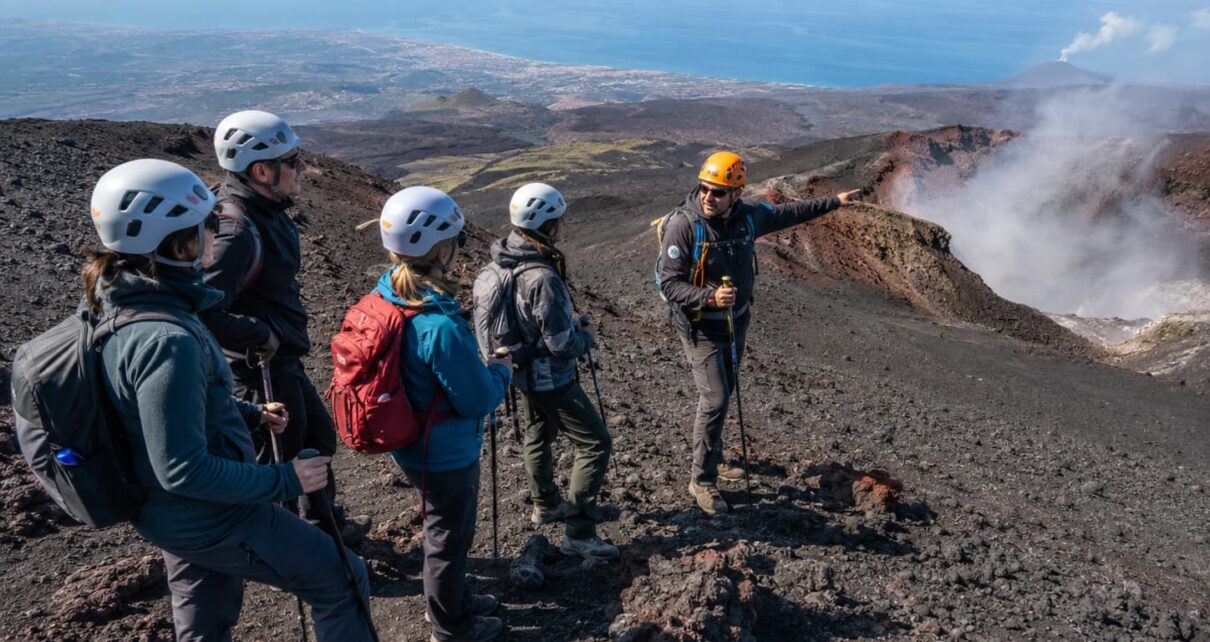
Mount Etna, on the eastern coast of Sicily, is one of the most continuously newsworthy locations in Europe. Europe’s tallest and most active volcano, it has erupted in some form in almost every year of recorded history and produces major lava flows and ash events on a schedule that no other European geological feature can match. Scientists, journalists, photographers, and documentary crews are a constant presence on its slopes. The communities around it have been managing the relationship between their lives and the volcano for three thousand years. For a journalism student who wants to understand what it feels like to cover a live, unpredictable, technically complex story in a challenging physical environment, Etna is a field school that pays for itself.
Here are eight reasons to go.
1. Etna Is One of the Most Continuously Covered Science Stories in the World
The Istituto Nazionale di Geofisica e Vulcanologia maintains a permanent monitoring network on Etna with seismometers, GPS stations, gas sensors, and thermal cameras covering the volcano’s four summit craters and the major rift zones on its flanks. The data from this network is published in near real time, feeds into eruption alert systems, and has been the basis for hundreds of peer-reviewed scientific papers. The INGV’s Etna Observatory issues regular bulletins that are picked up by Italian and international media on every significant eruption.
What this means for a journalism student is that Etna is a place where the science-to-public pipeline is active and observable. You can watch how a scientific bulletin becomes a news report. You can see which details the journalists use, which they discard, where they get the translation wrong and where they get it right. The gap between what the volcanologist says and what appears in a general news article is frequently significant, and studying that gap in a place where both the science and the journalism are operating at high volume is one of the most instructive exercises in science communication available to a student reporter.
2. Field Reporting Requires Physical and Environmental Literacy That Classrooms Cannot Teach
Covering Etna as a journalist means working in an environment where the ground is hot in places, where gas emissions vary in concentration without warning, where weather changes rapidly with altitude, and where the visual landscape changes between visits. The upper slopes above 2,500 metres are cold even in summer. The lava fields are unstable underfoot. The ash clouds from summit activity can affect visibility and air quality across a wide area at short notice.
The physical intelligence required to work effectively in this environment, knowing where to position yourself for the best visual access without taking unnecessary risk, understanding when a change in wind direction means you need to move, reading the landscape quickly enough to make good decisions under pressure, is the same physical intelligence that experienced field reporters deploy in any challenging location, from flood zones to wildfire fronts to conflict borders. Etna does not carry the life-threatening risk of those environments, but it provides a calibrated version of the same physical and situational awareness challenge that separates field reporting from desk reporting.
3. The Story Has Local, National, European, and Global Dimensions Simultaneously
A significant Etna eruption is news at several different scales at once, and each scale requires a different reporting approach. At the local level, the story is about the farming communities on the volcano’s fertile slopes, the decision to plant vineyards in the path of previous lava flows, the insurance claims, the evacuations, the relationship between risk and livelihood that Sicilian farming families have managed across generations. At the national level, it is a civil protection and infrastructure story: road closures, airport disruptions at Catania, the response capacity of Italian emergency services. At the European level, it is a geoscience story with implications for research funding, monitoring infrastructure, and volcanic risk policy. At the global level, it is a climate story, since volcanic emissions interact with atmospheric chemistry in ways that affect global temperature records.
Most journalism training focuses on one scale at a time. Etna forces you to think about all of them simultaneously and to understand how the same event generates different story angles depending on which audience you are writing for. That multi-scale thinking is one of the hardest skills in journalism to develop without a real story to practise on.
4. Science Source Access on Etna Is More Open Than Almost Anywhere Else
The concentration of active research on Etna, from the INGV network to visiting academic teams from across Europe and beyond, creates an unusual situation for a journalist: the experts are accessible, they are accustomed to talking to media, and many of them are actively interested in how the science reaches the public. The INGV Etna Observatory runs an outreach program and has staff who are experienced in explaining volcanic processes to non-specialist audiences.
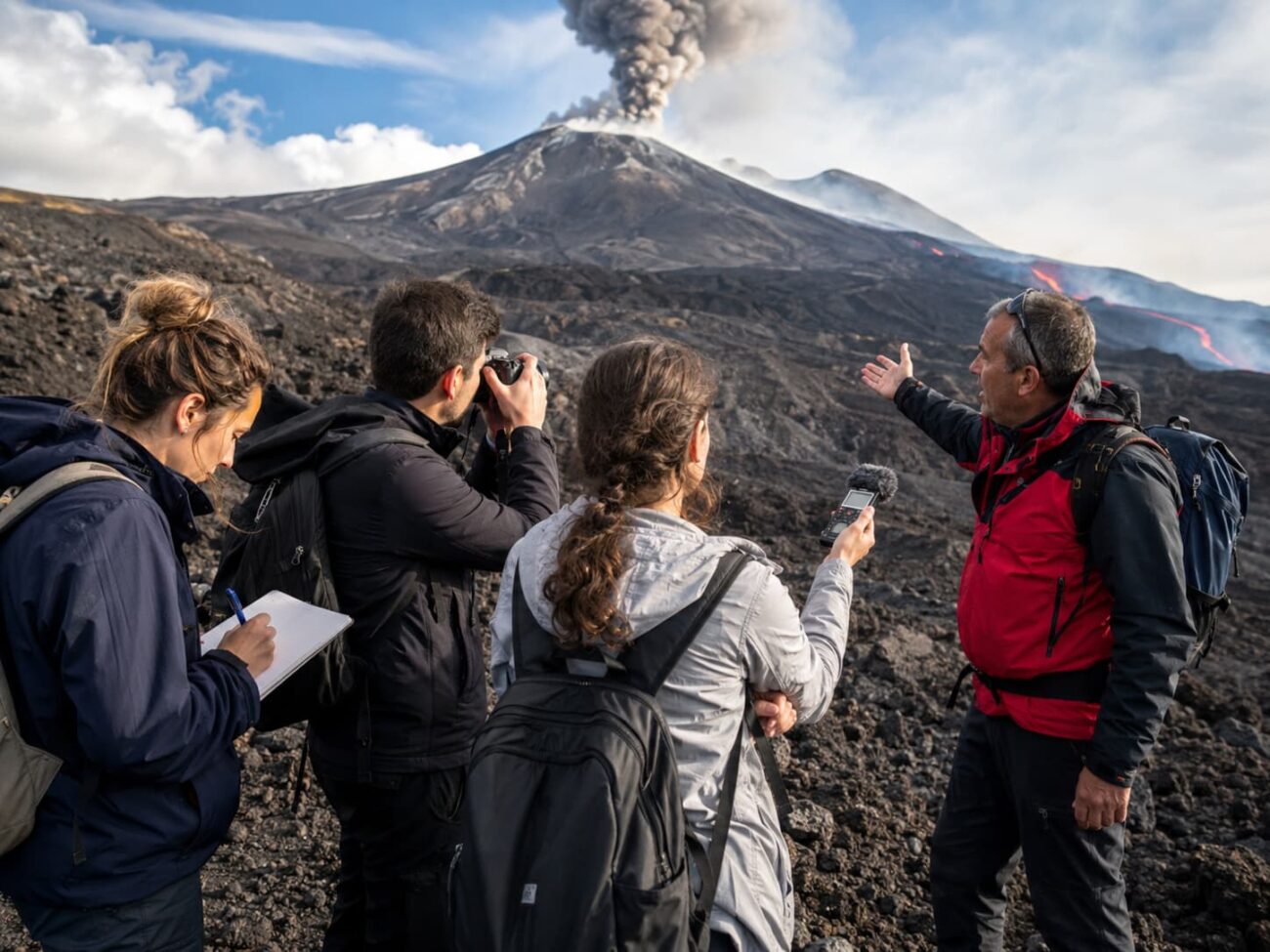
For journalism students learning to work with scientific sources, this accessibility is valuable. Getting a volcanologist to explain what they are observing in terms a general reader can understand, without oversimplifying to the point of inaccuracy, is exactly the skill that science journalism requires and that most student reporters never practise with a real expert in a real field setting. The principles covered in our guide to mastering news writing skills include source development and interview technique, and there is no better context to practise these with scientific sources than a place where world-class researchers are routinely available and motivated to engage.
5. The Visual Storytelling Opportunities Are Exceptional for Multimedia Work
Volcanic activity produces visual content that is difficult for any journalism student to ignore and impossible to replicate in any other environment. A lava flow at night, glowing orange against the dark landscape. The ash plume rising from a summit crater and drifting downwind over the Sicilian coast. The contrast between the fertile green vineyards on the lower slopes and the black lava field from the last eruption a few hundred metres above them. The thermal imagery from the INGV monitoring cameras showing the heat signature of the active vents in real time.
Multimedia journalism requires exactly this kind of multi-modal visual story: still images, video, data visualisation, and archival footage that can be combined to tell a story across different platforms and formats. Our guide to multimedia journalism and media platforms covers the skills involved in building these cross-format stories, and Etna provides the content that makes practising those skills feel like real work rather than an exercise.
6. Guided Tours Provide Access to the Volcanic Terrain That Independent Visitors Cannot Safely Reach
The summit craters of Etna and the active lava field areas on the upper flanks are not safely accessible without a licensed guide who knows current conditions. The situation on the mountain changes with each eruptive phase, and areas that were safe to approach in the previous season may be closed or hazardous in the current one. Visiting with a guide is also a source encounter: a licensed Etna guide knows the volcano’s behaviour, can read the signs of changing activity, and provides the kind of contextual knowledge about the specific landscape that a journalist covering the story needs.
Operators like Sicily Mount Etna Tours run guided excursions to the summit area and the active lava fields with licensed guides who understand the current volcanic situation and can access areas of the mountain that are closed to unaccompanied visitors. For journalism students who want the closest possible field access to the story, a guided tour is both the safest and the most informationally rich way to experience the mountain.
7. The Surrounding Sicilian Context Is a Story in Its Own Right
Etna does not exist in a vacuum. The communities on its slopes, the wine producers who cultivate the mineral-rich volcanic soils, the towns that have been rebuilt after historic lava flows, and the civil protection infrastructure that monitors and responds to volcanic events are all part of a human story that surrounds the geological one. The village of Zafferana Etnea, which was threatened by a lava flow in 1992 and saved by a combination of earthworks and, in a controversial decision, aerial bombing of the lava tube feeding the flow, is a case study in emergency decision-making and risk communication that a journalism student could spend a week reporting.
Sicily itself, with its layers of Greek, Arab, Norman, and Spanish history overlaid on a volcanic landscape, offers the kind of deep contextual richness that makes a reporting trip more valuable than a day visit. Catania, the nearest city to Etna, was largely destroyed by eruption in 1669 and then by earthquake in 1693, and was rebuilt in the distinctive Sicilian Baroque style using black lava stone from the volcano that destroyed the previous city. The rebuilt city is a monument to the human capacity to find beauty in the materials of disaster, which is itself a journalism story about how communities narrate catastrophe.
8. Reporting From a Live Volcanic Environment Tests Every Journalism Instinct at Once
The qualities that distinguish a capable field journalist from a desk journalist are not primarily technical. They are attentional: the ability to notice what is significant in a complex, rapidly changing environment; to ask the question that captures what the audience most needs to know; to file an accurate account of something you have only partially understood while it was still happening; and to do all of this while managing your own physical position and safety in an environment that does not stop moving while you work.
Etna tests all of these at a manageable level of intensity. The environment is complex and changing. The story is real. The sources are authoritative. The visual material is compelling. The risk is present but managed by the guide’s expertise. And the story connects to questions that journalism has always been most important for: how do communities understand and communicate risk? Who decides when an area is safe? How does scientific uncertainty translate into public guidance? What do people choose to preserve and what do they choose to abandon when the lava moves toward them?
These are questions worth reporting. Going to the place where they are being answered in real time is worth the flight to Sicily.
A Final Thought
Journalism students who spend time at Etna come back with something that courses alone cannot provide: a physical memory of what it is to be in the presence of an ongoing, uncontrollable, consequential story. The volcano does not stop erupting for your deadline. The science does not simplify itself for your word count. The local farmers do not pause their anxiety about next season’s harvest to give you a cleaner quote.
That is the field. Working in it, even briefly, changes how you read your own copy afterward. You know, in your body rather than just your notes, what it costs to get a story right when the story is actually happening.
The volcano will still be erupting when you arrive. That is the point. Go in the active season, between spring and autumn. Hire a licensed guide for the upper slopes. Bring a notebook, a good camera, and the patience to wait for the source who knows what they are talking about. The rest of it is journalism.